Research

IV-ICL: Bounding Causal Effects with Instrumental Variables via In-Context Learning [arXiv]
Preprint, 2026
IV-ICL is an amortized Bayesian in-context learning method for bounding causal effects from instrumental variables. A single transformer maps an observational dataset directly to the marginal posterior over the (partially identified) causal effect, using an inclusive-KL objective to faithfully recover the identified set.
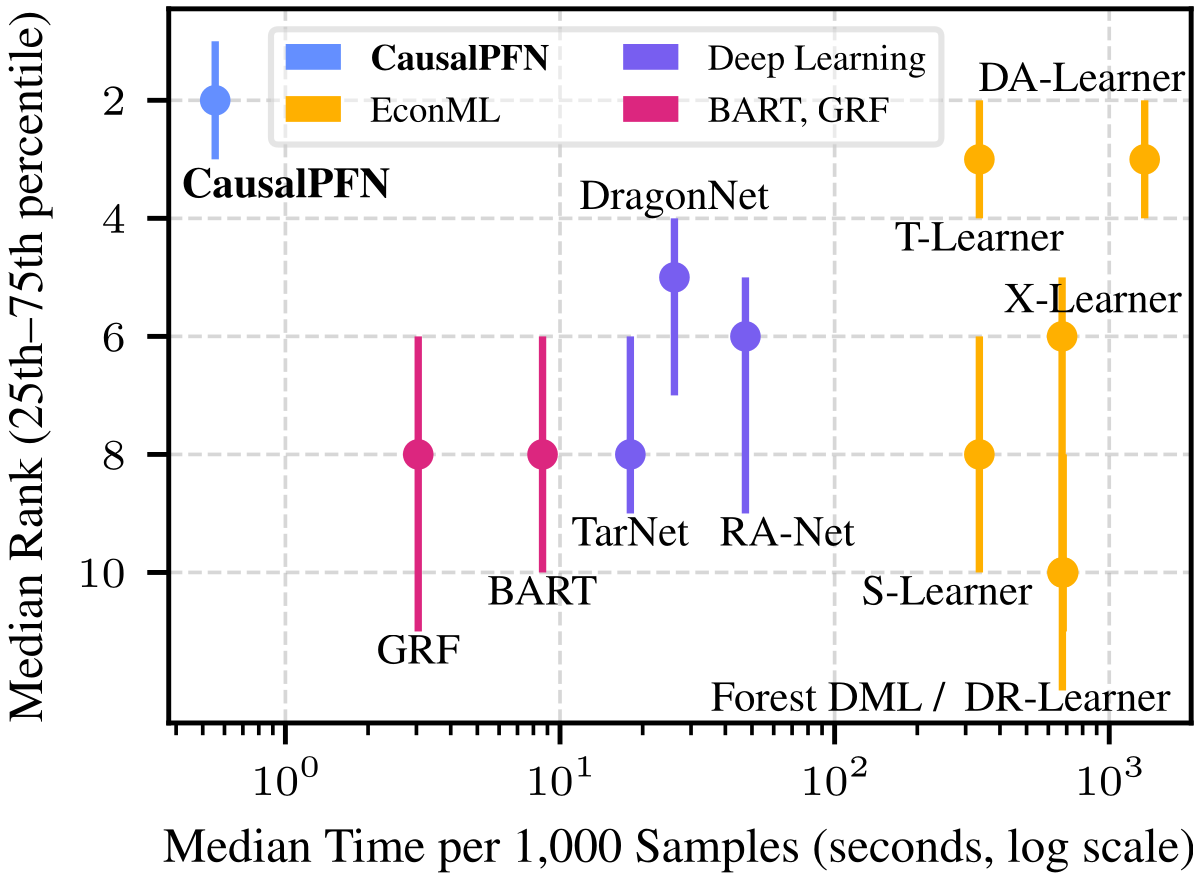
CausalPFN: Amortized Causal Effect Estimation via In-Context Learning [arXiv], [Code]
NeurIPS 2025 (Spotlight, top 3%)
CausalPFN is a single transformer, trained once on a large library of simulated data-generating processes that satisfy ignorability, and estimates causal effects for new observational datasets out of the box. It combines Bayesian causal inference with the training protocol of prior-data fitted networks to map raw observations directly to average and heterogeneous treatment effects, together with calibrated uncertainty, without any task-specific tuning. It achieves strong performance across standard benchmarks (IHDP, Lalonde, ACIC) and real-world uplift-modeling tasks.
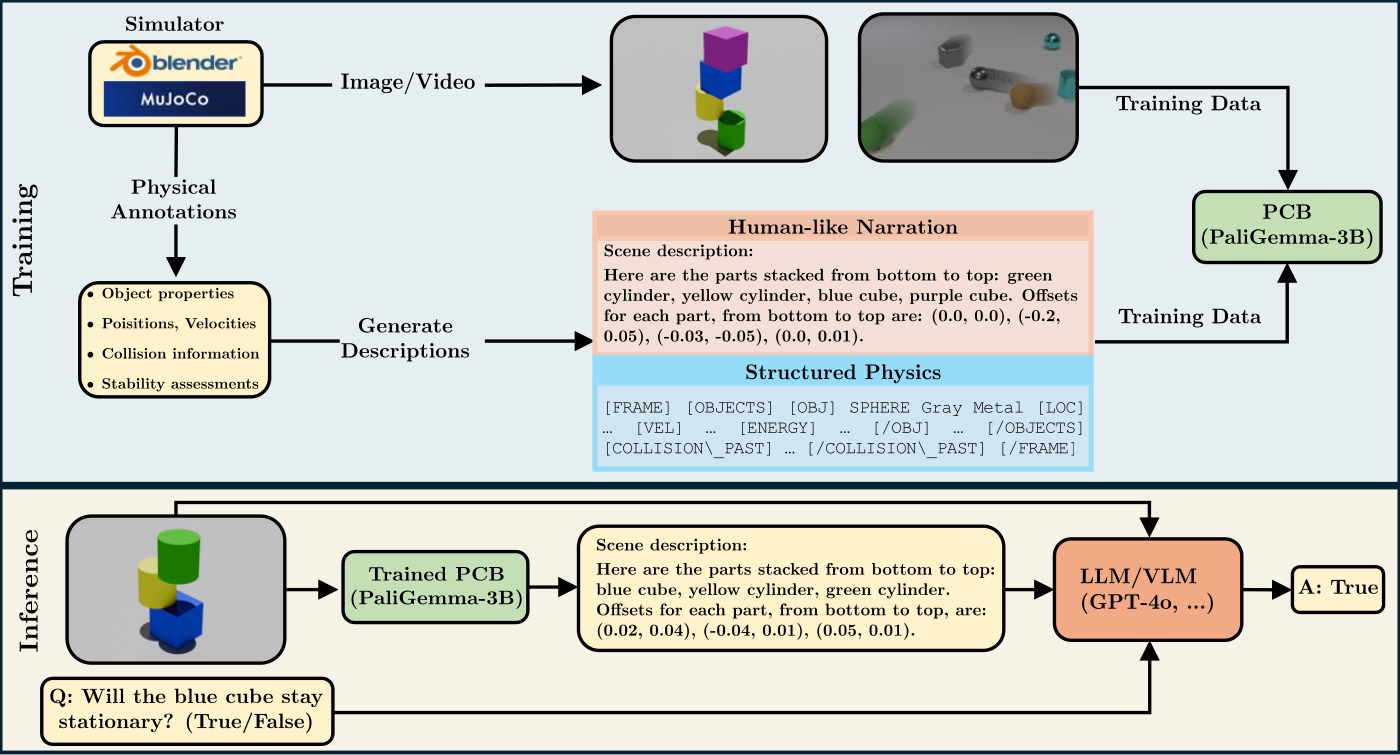
Physics Context Builders: A Modular Framework for Physical Reasoning in Vision-Language Models [PDF]
ICCV 2025
Physics Context Builders (PCBs) is a modular framework in which specialized smaller VLMs are fine-tuned to generate detailed physical scene descriptions, which then serve as physical context to enhance the reasoning of larger VLMs. This separation of visual perception from reasoning allows us to analyze their relative contributions to physical understanding.

Sequential Decision Making with Expert Demonstrations under Unobserved Heterogeneity [arXiv], [Code]
NeurIPS 2024
We present the Experts-as-Priors (ExPerior) algorithm for online decision-making from offline expert demonstrations under unobserved contextual information. ExPerior frames this setting as a zero-shot meta-reinforcement learning task, employing a non-parametric empirical Bayes approach with a maximum-entropy informative prior. Our method surpasses existing algorithms in leveraging expert demonstrations across various setups.

Partial Identification of Treatment Effects with Implicit Generative Models [arXiv], [Code]
NeurIPS 2022
We address the challenge of partial identification, estimating bounds for treatment effects from observational data using deep generative modeling. We introduce a method for identifying average treatment effects (ATEs) in general causal graphs, using implicit generative models with continuous and discrete variables. Our algorithm converges to tight ATE bounds in linear structural causal models (SCMs), and for nonlinear SCMs the bounds are tighter and more stable than those of existing methods.